A Brand Strategy Framework That Works
Updated: May 31
When a business says its marketing is underperforming, the problem often starts earlier than the campaign. Poor conversion rates, inconsistent messaging, rising acquisition costs, and weak brand recall usually point to the same issue - there is no clear brand strategy framework holding the business together.
That matters because brand is not a design layer added at the end. It is the commercial logic behind how you position, communicate, and compete. Without that logic, teams make disconnected decisions. Sales tells one story, the website tells another, paid media targets the wrong value proposition, and content becomes a stream of activity with no cumulative effect.
A useful framework fixes that. It gives leadership a sharper point of view, gives marketing clearer direction, and gives creative work a strategic role rather than a decorative one.
What a brand strategy framework actually does
A brand strategy framework is a structured way to define how your business should be understood in the market and how that position should show up across every customer touchpoint. It turns broad ambition into operational clarity.
For growing businesses, that clarity has a direct commercial payoff. It shortens decision-making, reduces wasted marketing spend, improves internal alignment, and helps customers understand why they should choose you over alternatives. That last point is critical. If your market cannot quickly grasp what makes you different and relevant, performance marketing becomes more expensive because every campaign has to work harder to create meaning from scratch.
This is where many businesses go wrong. They treat brand strategy as either a workshop exercise or a visual identity project. In practice, it should do more than produce a positioning line and a refreshed logo. It should create a system that informs your offer, your messaging, your content, your campaign structure, and the way your business is remembered.
The core of a strong brand strategy framework
A good framework does not need to be bloated. In fact, the most effective ones are usually quite disciplined. They focus on a small number of strategic decisions that shape everything downstream.
1. Market context
Before you define your brand, you need to understand the space you are operating in. That includes competitor patterns, category expectations, customer buying triggers, and the language your market already uses. The goal is not to copy what others are doing. It is to identify where the market is crowded, where claims feel generic, and where there is room to establish a stronger position.
Some categories reward reassurance and credibility. Others reward speed, innovation, or specialist depth. If you skip this step, you risk building a brand that sounds good internally but fails to land externally.
2. Audience clarity
Most businesses claim to know their audience. Far fewer can clearly articulate what their best-fit customers are trying to achieve, what barriers sit in the way, and what criteria drive selection. Demographics rarely get you far enough. Commercially useful audience insight looks at motivation, hesitation, urgency, and decision dynamics.
That has practical implications. A founder-led business speaking to procurement teams needs a different message architecture than a consumer brand selling on emotion and convenience. The framework should account for how decisions are really made, not just who makes them.
3. Positioning
Positioning is the strategic centre of the framework. It defines the specific place your brand should occupy in the minds of customers relative to competitors. Strong positioning is not a slogan. It is a choice.
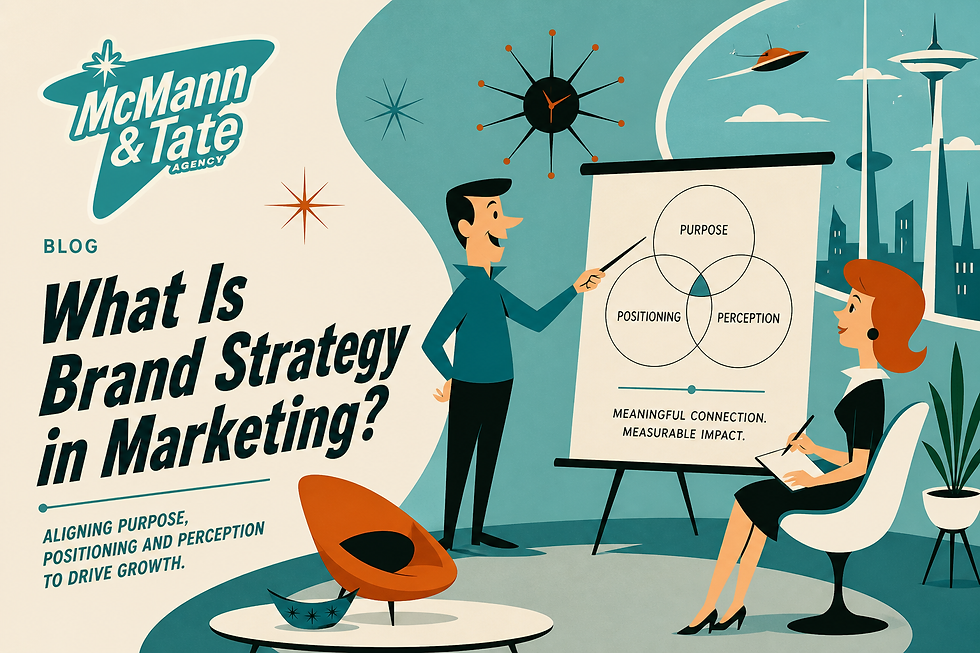
That choice usually sits at the intersection of customer relevance, commercial strength, and market differentiation. If it is only different but not useful, it will not convert. If it is useful but indistinguishable from everyone else, it will not build preference. The job is to land on a position that is both credible and meaningful.
4. Value proposition
Your value proposition translates positioning into a clearer commercial promise. It answers a simple question: why should a customer choose you, and what outcome can they reasonably expect?
This needs precision. Vague claims such as quality service or tailored solutions add very little because they are market default statements. Stronger value propositions are tied to specific outcomes, clearer proof points, or a sharper delivery model. For example, an integrated agency model can be valuable not because it sounds bigger, but because it removes fragmentation and improves execution speed across brand, content, and media.
5. Messaging structure
Once the strategic core is in place, messaging turns it into communication assets teams can actually use. That usually includes a primary brand message, supporting pillars, proof points, audience-specific variations, and clear language rules.
This is where alignment starts to show up. Your website, proposals, campaigns, sales material, and content should not all be saying different versions of the truth. A structured messaging system gives the business a consistent commercial narrative without forcing every channel to sound identical.
6. Brand expression
Visual identity and verbal tone matter, but they need to be downstream of strategy. Expression should reinforce the position rather than compensate for the lack of one.
A premium-looking identity cannot fix weak differentiation. Equally, a strong strategic position can be diluted by generic design and inconsistent tone. The right expression makes the brand easier to recognise, easier to trust, and easier to remember.
Why many brand strategy frameworks fail in practice
The issue is rarely the framework itself. It is usually what happens after it is written.
Some frameworks are too abstract to guide execution. They sound intelligent in a boardroom but offer no practical direction for campaign planning, content production, or sales messaging. Others are too inward-looking. They reflect how the leadership team wants to be seen rather than how the market actually evaluates options.
There is also a common disconnect between strategy and delivery. A business invests in positioning work, then hands execution to separate internal teams or external suppliers who were not part of the strategic process. The result is dilution. The strategic intent gets lost as it moves from planning into design, copy, paid media, and web implementation.
That is why end-to-end alignment matters. Strategy should not sit in a slide deck. It should shape channel priorities, campaign angles, landing page messaging, creative decisions, and content themes. At McMann and Tate Agency, that connection between strategic foundations and execution is where much of the commercial value sits.
How to assess whether your current framework is working
If you already have brand guidelines or a positioning document, the question is not whether they exist. The question is whether they are improving business performance.
A working framework usually shows up in a few clear ways. Internal teams can explain the brand consistently. Marketing activity feels more focused. Sales conversations become easier because the value proposition is clearer. Creative work has a stronger point of view. Customer response improves because the market can understand the offer faster.
If none of that is happening, your framework may be incomplete or disconnected from execution.
Another useful test is to look at your channels side by side. Does your website headline reflect the same strategic position as your paid ads, your capability deck, your social content, and your sales outreach? If not, the issue is not channel performance in isolation. It is strategic inconsistency.
Building a brand strategy framework with commercial discipline
The strongest frameworks are not built by chasing originality for its own sake. They are built by making disciplined choices around who you serve, what you stand for, and how that translates into market-facing execution.
That often means saying no to broad, catch-all messaging. It can feel safer to appeal to everyone, but broad positioning tends to weaken both brand and performance. Specificity creates traction. It gives customers a clearer reason to care and gives marketing a sharper brief.
It also means balancing long-term brand equity with short-term demand generation. This is not an either-or decision. A good framework supports both. It makes performance marketing more efficient because the market-facing message is stronger, and it builds memory over time because the same strategic signals are repeated consistently.
There are trade-offs, of course. A highly specialised position may reduce immediate breadth while increasing conversion quality. A broader position may open more doors but lower distinction. The right choice depends on your business model, sales cycle, market maturity, and growth goals. What matters is that the choice is deliberate.
Brand strategy framework and growth
For leadership teams, the value of a brand strategy framework is not theoretical. It is operational and financial. It helps the business decide what to say, where to compete, and how to bring marketing, sales, and creative into the same commercial system.
Without that system, growth becomes harder than it needs to be. Teams spend more time rewriting messages, redesigning assets, and fixing inconsistency than building momentum. Campaigns may still run, but they are forced to carry strategic weight they were never designed to hold.
The better approach is simpler. Get the foundations right, then execute with consistency. When strategy, creative, and marketing are aligned, the business becomes easier to understand and harder to ignore.
If your brand feels fragmented, your message keeps shifting, or your marketing performance depends too heavily on constant spend, it may not be a channel problem at all. It may be time to build a brand strategy framework that gives every part of the business a clearer job to do.
McMann and Tate Agency
Contact us today fayssal@mandtagency.com.au or 0423006569


Comments