What Is Brand Strategy in Marketing?
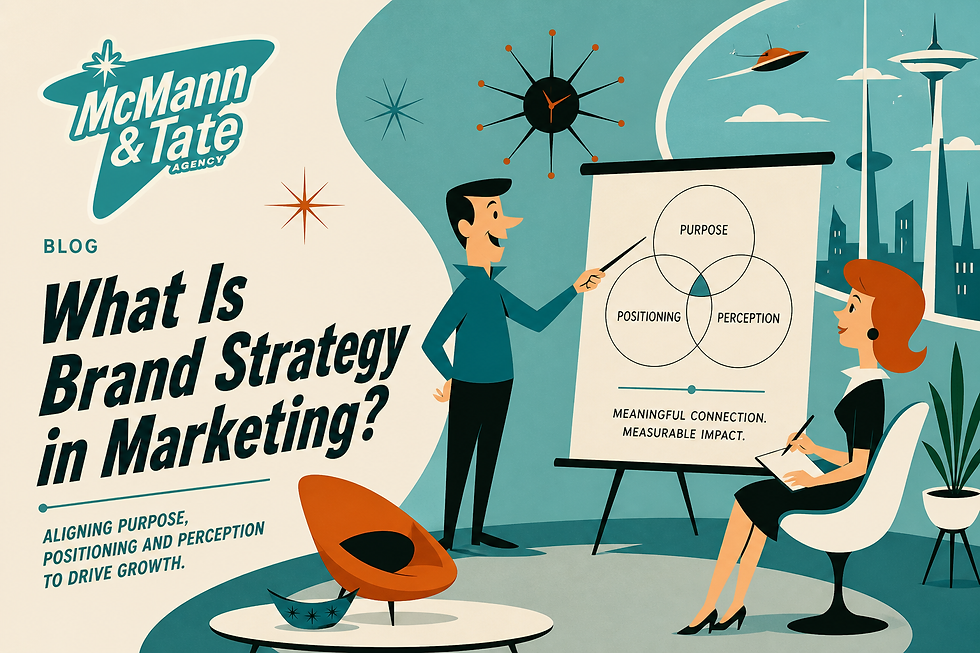
If your marketing feels busy but not especially effective, there’s a fair chance the problem isn’t your ads, website or content calendar. It’s what sits underneath them. That’s where the question what is brand strategy in marketing starts to matter - because brand strategy is the part that stops your business from sounding like everyone else with a Canva account and a quarterly sales target.
Brand strategy is the plan for how your business will be perceived, remembered and chosen. In marketing, it gives your campaigns direction so they’re not just making noise. It defines who you are, who you’re for, what makes you different and how that difference shows up across every touchpoint people see.
In plain English, brand strategy is the thinking before the tactics. It’s the reason your marketing has a point of view instead of a collection of disconnected activities.
What is brand strategy in marketing, really?
A lot of businesses hear “brand” and picture logos, colours and fonts. Important, yes. The whole story, not even close.
Brand strategy sits beneath the visual layer. It covers your positioning in the market, your value proposition, your audience, your message, your personality and the promise you want customers to associate with you. If your brand identity is the costume, brand strategy is the script, casting and direction.
Marketing uses that strategy to attract attention and drive action. Without it, you can still run campaigns. You can still post on social media, buy media, send EDMs and tweak landing pages. But the work often feels inconsistent because there’s no central idea holding it together.
That’s why strong brand strategy does more than make a business look polished. It makes marketing more efficient. Teams create faster, campaigns align better and customers understand why they should care.
Why brand strategy matters to marketing performance
Here’s the trade-off many businesses miss. Performance marketing can generate quick wins, while brand strategy builds long-term preference. You need both.
If you only invest in short-term tactics, you might get clicks without loyalty, leads without fit, and traffic without trust. On the other hand, if you obsess over brand theory and never activate it, you end up with a lovely strategy deck gathering dust in the digital void.
Good marketing needs a bridge between the two. Brand strategy gives paid campaigns sharper messaging. It helps content focus on the right themes. It improves conversion because the offer feels clearer and more credible. It also supports pricing power. People are less likely to shop purely on cost when they understand your value and recognise your difference.
This matters even more in crowded categories. When ten competitors offer a similar service, the winner is rarely the one shouting the loudest. It’s usually the one with the clearest position and the most consistent story.
The core parts of a brand strategy
Brand strategy isn’t one document or workshop. It’s a set of decisions that shape how the market sees you.
Positioning
Positioning is the space you want to occupy in your customer’s mind. Not in your boardroom. Not on your whiteboard. In their mind.
It answers questions like: who are we for, what problem do we solve, what category are we in, and why are we a better choice than the alternatives? Strong positioning is specific. Weak positioning tries to appeal to everyone and ends up memorable to no one.
Audience clarity
You can’t build a compelling brand around a vague idea of “business owners” or “people who need marketing”. A strategy should define the audience in a way that helps you make better decisions. What are they trying to achieve? What frustrates them? What language do they use? What matters when they compare providers?
This is where nuance matters. Two brands can sell the same service but need completely different messaging because their buyers have different priorities.
Value proposition
Your value proposition is the commercial heart of the strategy. It explains the benefit customers get and why it’s worth choosing you.
A good one goes beyond generic claims like quality service or tailored solutions. Every second business says that. Your value proposition needs to connect to a real customer need and a real market gap.
Messaging
Messaging turns strategic thinking into language your audience can actually understand. This includes your core message, proof points, offer framing and tone of voice.
This is where many brands wobble. They know what they do, but they say it in five different ways depending on who’s writing the page, ad or proposal. Brand strategy fixes that by giving everyone the same playbook.
Brand personality and identity direction
Personality shapes how your brand sounds and feels. Identity direction shapes how it looks. These should reinforce the strategy, not decorate it.
For example, a premium advisory firm may need restrained, confident branding. A challenger retail brand might need bold energy and a bit more edge. Neither is inherently better. It depends on the audience and the job the brand needs to do.
What brand strategy is not
Brand strategy is not just a logo refresh. It is not a tagline brainstorm squeezed into a Tuesday afternoon. And it definitely isn’t choosing a few nice colours and hoping customers interpret them as market leadership.
It’s also not empty theatre. The point isn’t to sound clever. The point is to make the business easier to understand, easier to trust and easier to choose.
That means strategy has to connect with reality. Your market position needs to be believable. Your promise needs to be deliverable. Your message needs to line up with the actual customer experience. If there’s a gap between the story and the service, customers will spot it quickly.
How brand strategy shapes day-to-day marketing
This is where the work earns its keep. Once your brand strategy is clear, marketing decisions become less guesswork and more judgement.
Campaigns can target the right audience with sharper creative angles. Website copy can focus on the problems customers actually want solved. Sales teams can tell a more consistent story. Content stops drifting between random topics and starts building authority around a defined position.
Even channel choice improves. If your strategy says your buyers need reassurance and proof, you may prioritise case studies, email nurturing and search-led content. If your brand thrives on visibility and emotional pull, video and social creative may do more heavy lifting. Strategy doesn’t eliminate experimentation, but it gives it a better brief.
This is also where an integrated model helps. When strategy, creative and marketing execution sit together, the brand is less likely to fracture between departments or suppliers. That saves time, reduces mixed messages and gives the market a more consistent experience.
When a business needs to revisit its brand strategy
Some businesses need brand strategy at launch. Others need it when growth starts exposing the cracks.
If your messaging keeps changing, your leads are the wrong fit, your team can’t explain what makes you different, or your visual identity feels disconnected from the quality of your offer, it’s probably time. The same goes if your marketing spends money but struggles to build momentum.
There’s also a less obvious signal: you’ve outgrown the story you started with. Many founder-led businesses begin with a rough but workable message, then hit a point where the market gets more competitive and “word of mouth plus a decent website” no longer cuts it. That’s usually when strategy stops being a nice-to-have and starts becoming commercial infrastructure.
What is brand strategy in marketing for growth-focused businesses?
For growth-focused businesses, brand strategy is not a fluffy side quest. It’s the operating system behind effective marketing.
It gives your business a clear market stance. It aligns your message across channels. It helps your creative look like it belongs to the same company. And it gives performance marketing a stronger foundation so it can do more than chase low-hanging fruit.
That doesn’t mean every business needs a sprawling brand project with fifty-page manifestos and dramatic moodboards worthy of a film pitch. Some need a tighter, more practical piece of work. Others need a deeper reset. It depends on the business model, market maturity and growth goals.
What matters is that the strategy is clear enough to guide action. If it can’t inform your campaigns, sales conversations, content and customer experience, it’s not finished. It’s just interesting.
The best brand strategy doesn’t sit on a shelf looking handsome. It gets to work - making your marketing sharper, your team more aligned and your business far harder to ignore.
McMann and Tate Agency
Contact us today fayssal@mandtagency.com.au or 0423006569


Comments