What Is Strategic Branding, Really?
Updated: May 31

A lot of businesses think they have a branding problem when they actually have a clarity problem. The logo looks fine. The website is live. The socials are posting away. But the market still shrugs. That is usually the moment the real question appears: what is strategic branding, and why does it seem to separate brands people remember from brands people scroll past?
Strategic branding is the deliberate process of shaping how your business is understood, remembered and chosen. It is not just the visual layer. It is the thinking underneath the visuals, the words, the offers and the customer experience. Done properly, it gives your business a distinct place in the market and makes every piece of marketing work harder.
If branding is the character on stage, strategy is the script, casting and direction. Without it, you might still put on a show, but it will feel improvised. Entertaining for a minute, forgettable by morning.
What is strategic branding in practice?
In practical terms, strategic branding is the set of decisions that defines who you are, who you are for, what makes you meaningfully different and how that difference shows up everywhere your audience meets you.
That includes your positioning, your messaging, your voice, your visual identity and the way your brand behaves in the world. It also includes what you do not say, who you do not target and where you choose not to compete. That last part matters more than most businesses would like.
A strategic brand is built on choices. Not vague aspirations. Not a mood board with good lighting. Choices.
When a brand has strategy behind it, customers can quickly understand what it stands for. Sales teams can explain it without inventing a new pitch every week. Marketing becomes more consistent. Creative decisions get faster. Campaigns stop feeling like isolated stunts and start feeling like chapters in the same story.
Strategic branding is not just design with better vocabulary
Let us clear the stage. Strategic branding is not the same thing as a logo refresh, a prettier website or a clever tagline. Those can be useful outputs, but they are outputs, not the strategy itself.
Design gives your brand form. Strategy gives it direction.
This is where plenty of businesses get stuck. They invest in visuals before they have sorted out their market position, their audience priorities or their message. The result is a polished identity sitting on top of fuzzy thinking. It can look expensive and still underperform.
That is not a design problem. It is a business problem wearing nice shoes.
The strongest brands make design decisions that are anchored in commercial logic. Why this tone? Why this offer structure? Why this message hierarchy? Why should this audience care now, rather than later? Strategic branding answers those questions before the creative rolls out.
The core parts of strategic branding
At the centre of strategic branding is positioning. This is the space you want to own in the customer’s mind. Not everything you do, but the most relevant and persuasive thing you want to be known for.
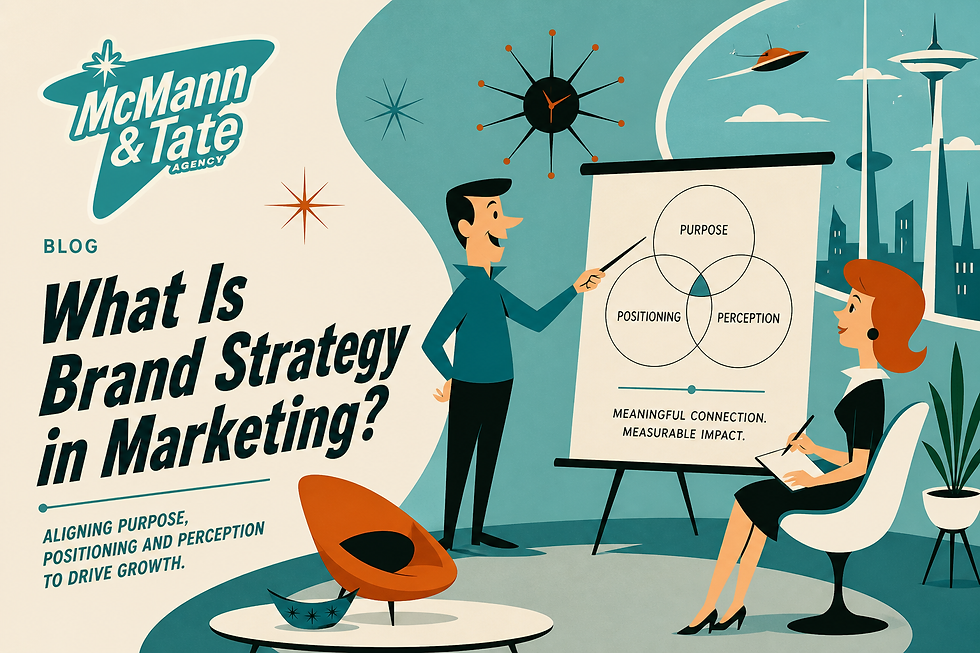
Strong positioning usually sits at the intersection of customer need, market gap and business strength. If one of those is missing, the brand starts wobbling. You might have something customers want, but so does everyone else. You might have a unique angle, but no real demand. You might have internal confidence in your offer, but no external proof that it matters.
Messaging sits right beside positioning. This is how your strategy becomes understandable. Good messaging does not just sound nice. It translates your value into language that customers recognise and trust. It makes the complex feel clear without making the brand sound generic.
Then there is identity, which includes visual design and verbal expression. This is where the strategy becomes visible and tangible. Colours, typography, imagery, tone of voice and content style all play a role, but they should reinforce the same strategic idea. If your messaging says premium and precise, while your visual identity says budget and cheerful, the audience will believe the mismatch.
Brand experience matters too. Every touchpoint either supports your position or quietly undermines it. Your proposal deck, your onboarding process, your social content, your packaging, your sales call follow-up - they all count. Strategic branding is not a one-off workshop followed by a folder of brand assets. It is an operating system.
Why strategic branding matters for growth
The easiest way to think about strategic branding is this: it reduces friction.
It helps the right customers understand you faster. It gives your team a consistent framework for decision-making. It improves the efficiency of your marketing because you are no longer reinventing your message every time you launch a campaign. And it strengthens recognition over time, which is handy when attention spans are being chewed up by everything else on the internet.
For growth-stage businesses, this becomes especially important. Once you move beyond founder-led sales and referral momentum, the cracks start to show. Different people describe the business differently. Campaigns look disconnected. The website says one thing, the sales team says another, and the brand identity belongs to a version of the company from three years ago.
Strategic branding brings the whole thing into alignment.
That does not mean it magically fixes every commercial issue. If the offer is weak, the service is poor or the market timing is off, branding will not save the day like a heroic third-act monologue. But when the fundamentals are solid, strategic branding amplifies them. It helps good businesses become easier to choose.
What strategic branding looks like when it is missing
You can usually spot the absence of strategic branding pretty quickly. The business has inconsistent messaging across channels. The visual identity feels disconnected from the quality of the offer. Paid campaigns generate clicks but poor conversion. Teams spend too much time debating subjective creative preferences because there is no agreed strategic filter underneath.
Another sign is when a brand leans heavily on broad claims like quality, innovation or great service. Those phrases are not wrong, but they are rarely differentiating. If everyone in your category says the same thing, customers have no reason to remember you, let alone pick you.
Without strategic branding, marketing tends to become reactive. You try trends. You test ads. You redesign pages. You produce content. Some of it works a bit. Most of it fades quickly. There is motion, but not much momentum.
What is strategic branding worth to a business?
Its value shows up in both obvious and less obvious ways.
At the commercial end, strategic branding can improve conversion by making your proposition clearer. It can support stronger pricing by creating perceived value. It can shorten decision cycles because customers understand the offer faster. It can also make customer acquisition more efficient because your campaigns are built on sharper targeting and more relevant messaging.
Internally, it creates alignment. Teams can make decisions with more confidence because they know what the brand stands for and how it should show up. That matters in fast-moving businesses where inconsistency tends to creep in through perfectly reasonable chaos.
There is also a compounding effect. A strategically built brand becomes more recognisable over time because it repeats the right signals consistently. Not identical signals. Consistent ones. There is a difference. The best brands evolve without becoming unrecognisable to themselves.
When a business should invest in strategic branding
Not every business needs a full strategic branding project this Tuesday. Sometimes a lighter recalibration is enough. Sometimes the real issue sits in product-market fit or sales execution, not brand strategy.
Still, there are common moments when strategic branding becomes especially valuable. One is when growth has outpaced clarity. Another is when the business is changing direction, entering a new market or trying to attract a different kind of customer. It is also worth looking at when your marketing output feels busy but underpowered, or when your internal team cannot describe the brand in the same language.
This is where an integrated agency approach tends to earn its keep. Strategy on its own can become shelfware. Creative without strategy becomes decoration. Performance marketing without either can feel like setting fire to your media budget with unusual confidence. Bringing strategy, creative and execution together gives the brand a fighting chance to perform in the real world, not just in a presentation deck.
The trade-offs most businesses ignore
Strategic branding requires commitment. Once you define a clear position, you are also deciding what you are not. That can feel uncomfortable, especially for businesses worried about limiting their appeal.
But trying to appeal to everyone usually creates a brand that lands softly with everyone. Broad appeal sounds safe. In crowded markets, it is often the riskier option.
There is also a timing trade-off. Good strategy takes thought. It asks hard questions. It may reveal that the issue is not your logo but your offer architecture, your audience focus or your market assumptions. That can be inconvenient. It is also useful.
The point is not to create a brand document that sounds impressive in a boardroom. The point is to build a brand that can carry its weight in sales conversations, marketing campaigns and customer decisions.
A brand should not just look the part. It should know its lines, hit its mark and leave the right audience wanting more. If your business is growing, changing or simply tired of blending into the scenery, strategic branding is often the difference between making noise and making an impression.
And that is a far better place to start than another round of polishing the logo and hoping for applause.
McMann and Tate Agency
Contact us today fayssal@mandtagency.com.au or 0423006569


Comments