What Is Company Strategy, Really?

Most businesses don’t fail because the team lacks effort. They fail because everyone is running fast in slightly different directions. Sales is chasing one kind of customer, marketing is talking to another, and leadership is making calls based on whatever fire is hottest that week. If you’ve ever wondered what is company strategy, that’s the mess it’s meant to fix.
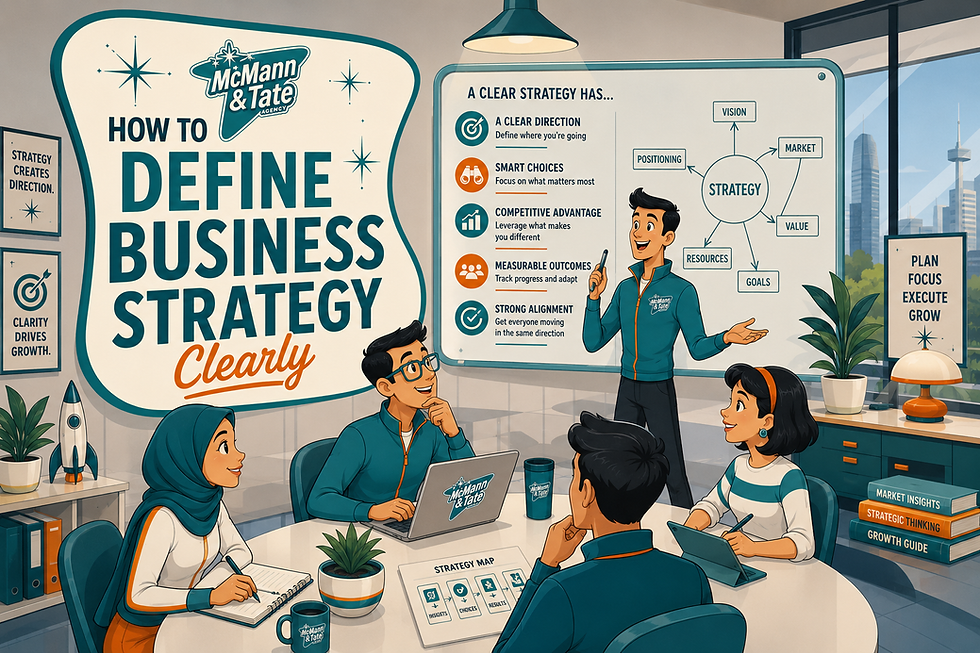
Company strategy is the set of deliberate choices a business makes about where it will play, how it will win, and what it will not do. It gives direction to decisions that would otherwise become reactive, scattered, or expensive. A proper strategy doesn’t just sound clever in a boardroom. It shapes priorities, budgets, hiring, messaging, offers, and growth plans in the real world.
That’s the plain-English version. The more useful version is this: strategy is the logic behind your business. It explains why your company exists in a crowded market, who it serves best, what advantage it can build, and how all of that turns into sustainable results.
What is company strategy in practice?
In practice, company strategy is not a mission statement framed near reception. It’s not a yearly planning day with too many sticky notes and not enough decisions. And it’s definitely not a wishlist dressed up as a roadmap.
A real company strategy answers a handful of hard questions. Which customers matter most? What problem are we best placed to solve? What position do we want to own in the market? What capabilities do we need to build? Where will we invest, and where will we hold back?
That last bit matters more than many leaders expect. Strategy is as much about exclusion as ambition. If you’re trying to be premium and low-cost, broad and niche, fast-moving and deeply customised all at once, you don’t have a strategy. You’ve got a buffet of conflicting intentions.
Good strategy creates alignment. It helps leadership make consistent calls. It gives marketing sharper messaging. It gives sales a clearer story. It helps operations know what to support and what not to over-engineer. Everyone starts pulling the same way, which is less glamorous than a rebrand but far more profitable.
Why businesses confuse strategy with planning
Here’s where things often go sideways. Businesses confuse strategy with plans, goals, and tactics.
A plan is how you intend to execute. A goal is the outcome you want. A tactic is a specific action you’ll take. Strategy sits above all three. It is the decision-making framework that makes those choices coherent.
Say your goal is to grow revenue by 20 per cent. Fine. That’s not a strategy. Running paid ads, launching a new website, and posting on LinkedIn are tactics. Also not strategy. Your strategy might be to focus on a higher-value customer segment, sharpen your positioning around a specific business problem, and build a service model that increases retention and referrals. Now the plan and tactics have somewhere sensible to live.
Without strategy, tactics become random acts of marketing. Plenty of businesses burn through budget this way. They redesign the logo, run a campaign, add another channel, then wonder why growth still feels patchy. The issue usually isn’t effort. It’s that the business hasn’t made enough clear strategic choices for those activities to compound.
The core parts of a strong company strategy
A strong strategy doesn’t need to be bloated. In fact, the best ones are often surprisingly crisp. But it does need a few essentials.
First, it needs a clear view of the market. That means understanding customer behaviour, competitor positions, demand patterns, pricing pressure, and shifts in the category. Not in an academic way. In a useful, commercial way.
Second, it needs a defined position. This is where many businesses get vague. They say things like quality service, tailored solutions, or customer-first. Lovely sentiment. Completely forgettable. Strategy asks a more pointed question: why should the right customer choose you over the alternatives available to them?
Third, it needs a business model that supports the promise. If your positioning says premium but your delivery model is chaotic, the strategy falls over on contact. If your marketing promises speed but operations can’t keep up, same problem. Strategy has to connect what you say to what you can actually deliver.
Fourth, it needs priorities. Not ten. Usually three or four at most. These are the big bets the business will focus on over a defined period. They might involve entering a new segment, improving margin, building brand visibility, increasing repeat business, or simplifying the offer. The point is to make the next set of decisions easier.
Finally, it needs trade-offs. This is the unsexy but crucial bit. What will you stop doing? Which customers are not the best fit? Which services create complexity without enough return? Which channels drain time but don’t move revenue? Strategy earns its keep when it helps you say no with a straight face.
What is company strategy without alignment? Not much.
A strategy that lives in a slide deck and nowhere else is theatre. Nicely lit theatre, perhaps, but still theatre.
For strategy to matter, it needs to show up across the business. Your brand should express it. Your messaging should reinforce it. Your sales process should support it. Your team should understand it well enough to make day-to-day decisions without needing a leadership séance every Tuesday.
This is where many growing businesses hit friction. Leadership may know where they want the company to go, but the brand story, website, campaigns, and customer experience tell a different tale. The result is confusion in the market and inconsistency inside the business.
That gap between strategy and execution is where momentum goes to die. It’s also why joining up brand, creative, and marketing matters. If strategy defines the role your business wants to play, execution is how the audience actually experiences it.
When strategy needs to change
Strategy should be stable enough to guide decisions, but not so rigid it ignores reality. Markets shift. New competitors emerge. Customer needs evolve. Economic conditions tighten. What worked three years ago may now be a lovely monument to a market that has moved on.
That doesn’t mean you rewrite your strategy every quarter because one campaign underperformed. It means you review it with discipline. Are we still targeting the right segment? Is our positioning still distinctive? Are our margins under pressure because the offer has drifted? Do our marketing and sales efforts support the same commercial goal?
Sometimes the answer is a small adjustment. Sometimes it’s a larger reset. Start-ups, for example, often begin with a broad offer to test demand, then narrow their strategy as they learn where they actually win. More mature businesses may need to simplify after years of adding services that looked profitable at the time but now muddy the waters.
It depends on your stage, market, and ambition. The trick is not to confuse consistency with stubbornness.
Signs your business doesn’t have a clear strategy
You can usually spot the absence of strategy without hiring a detective. Growth feels inconsistent. The team struggles to explain what makes the business different. Marketing output exists, but results are patchy. New opportunities keep appearing, yet none of them seem to build on each other.
Another sign is internal disagreement that never really resolves. Sales wants one thing, operations wants another, and leadership keeps changing direction based on the latest pressure point. Everyone is busy. Few people are aligned.
If that sounds familiar, the issue may not be talent or effort. It may be that the business hasn’t turned its ambition into a clear set of strategic choices.
How to make company strategy useful, not theoretical
Start with honesty. Not the polished version for a pitch deck. The real one. Where do you actually make money? Which customers are easiest to retain? What do clients value most? What causes drag? Where are you overcomplicating the offer? Which parts of the business are all noise and no margin?
Then turn that insight into decisions. Choose your target market with more precision. Clarify your position. Define the handful of priorities that matter now. Make sure your brand and marketing express the same strategic story, not a parallel universe version written by committee.
If you’re a founder or leadership team, this is the point where strategy stops being abstract and starts becoming operational. It shapes who you hire, what you measure, how you package services, and where you spend budget. At McMann and Tate Agency, that’s often the turning point we see with businesses ready to grow properly rather than just look busy.
A useful strategy should make decisions faster, not slower. It should reduce noise, sharpen communication, and give your business a stronger chance of being chosen for the right reasons.
Company strategy isn’t a corporate ornament. It’s the script behind the performance. And when the script is sharp, the whole cast has a much better shot at stealing the scene.
McMann and Tate Agency


Comments