What Is Business Strategy Development?

A lot of businesses think they have a strategy because they have a sales target, a marketing plan, and a group chat full of big ideas. That is not quite the same thing. If you are asking what is business strategy development, you are really asking how a business decides where it is going, why that direction matters, and what it will do to get there without wasting time, money, or momentum.
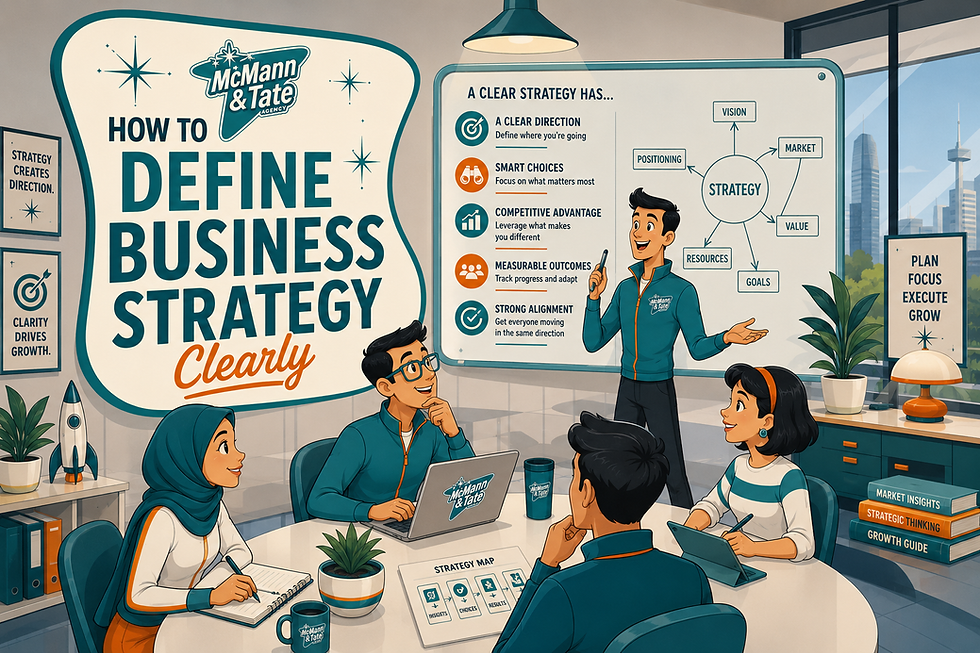
Business strategy development is the process of defining how a business will compete, grow, and win in its market. It connects ambition to action. Not the fluffy kind of action either. The kind that affects positioning, product decisions, pricing, hiring, marketing, customer experience, and investment.
Done well, it gives a business a clear path. Done poorly, it becomes a glossy document that sits in a folder while everyone goes back to making random decisions under pressure.
What is business strategy development really about?
At its core, business strategy development is about choice. A business cannot be everything to everyone, no matter how many inspirational slogans get thrown at the wall. Strategy decides where to play, how to win, what to prioritise, and what to leave alone.
That last part matters more than most leaders expect. Growth does not usually stall because there are not enough ideas. It stalls because there are too many disconnected ones. One team wants new markets, another wants a rebrand, someone else wants to cut prices, and marketing is being asked to somehow make it all look intentional.
Strategy development brings order to that chaos. It forces a business to look at its market, customers, competitors, capabilities, financial realities, and long-term goals in one frame. From there, it creates a direction that people can actually work from.
This is why strategy is not the same as planning. A plan says what you are going to do. A strategy explains why those moves make sense and how they support a stronger market position.
Why businesses need strategy before they need more activity
More effort is not always the answer. Sometimes it is just more noise with a budget attached.
A business without a clear strategy tends to chase tactics. It tries a campaign here, a new offer there, maybe a website refresh for good measure. Each move can look sensible on its own, but together they do not always add up to growth. They add up to motion.
Strategy development helps leaders make cleaner decisions because it sets the rules of the game. If your business knows who it serves best, what problem it solves better than others, and what commercial outcomes matter most, then it becomes much easier to judge whether an opportunity is worth pursuing.
That clarity is especially useful for founders and growing teams. When resources are tight, every decision has a cost. Strategy helps you spend your energy where it counts instead of spraying effort across every shiny option that rolls into view.
The building blocks of business strategy development
There is no single magic formula, and anyone promising one is probably wearing too much cologne. But strong strategy development usually includes a few core pieces.
First, there is business context. That means understanding where the business is now. Revenue trends, margins, customer behaviour, operational constraints, sales performance, brand perception, market shifts - all of it matters. Strategy built on guesswork is just theatre.
Then comes market insight. This is where businesses examine customer needs, competitor positions, category trends, and unmet opportunities. The goal is not simply to know what the market looks like. It is to identify where your business can create an advantage.
Next is positioning. This is where many businesses wobble. They know what they sell, but they struggle to explain why customers should choose them over someone else. Strategy development sharpens that answer. It defines the role your business wants to play in the market and the value it wants to be known for.
From there, strategic priorities are set. These are the major moves that will drive progress - things like entering a new segment, refining the offer, lifting retention, improving lead quality, building brand authority, or increasing operational efficiency. Not twenty priorities. A few that matter.
Finally, strategy development turns those priorities into decisions, measures, and action. That might include marketing direction, sales alignment, product focus, team structure, partnerships, or investment plans. Strategy should shape execution. Otherwise it is just a brainstorming session in nicer clothes.
What is business strategy development in practice?
In practice, it often starts with hard questions.
What are we trying to achieve in the next one to three years? Where is growth actually going to come from? Which customers are most valuable? What are we known for now, and is that helping or hurting us? What are we doing that looks busy but adds very little commercial value?
Those questions can be uncomfortable, which is usually a sign they are useful.
For a start-up, strategy development might centre on product-market fit, category positioning, and go-to-market focus. For a small business, it might involve tightening the offer, clarifying the brand, and choosing better acquisition channels. For a mid-sized business, it may be about scaling sustainably, improving margins, or aligning multiple departments around a single growth direction.
The process changes depending on the stage of the business, but the job stays the same - make smarter choices that improve long-term performance.
What strategy development is not
It is not a vision statement on the office wall.
It is not a yearly planning workshop full of coloured sticky notes and suspiciously expensive pastries.
It is not marketing alone, though marketing should absolutely be shaped by it. And it is not finance alone, even though the numbers have a big say in what is realistic.
Business strategy development sits above individual functions. It gives the entire business a shared commercial direction. Marketing then communicates and amplifies it. Sales turns it into revenue. Operations supports delivery. Leadership keeps the whole show pointed in the same direction.
When those pieces are disconnected, businesses feel inconsistent from the inside out. Customers notice. Staff notice. Results notice too.
The trade-offs that make strategy real
This is the part many businesses skip because it is less glamorous than saying you want to dominate the market.
Real strategy involves trade-offs. If you focus on premium positioning, you may lose price-sensitive customers. If you pursue rapid growth, you may need to accept short-term pressure on margins. If you narrow your target audience, your marketing may reach fewer people but convert more of the right ones.
That is not a flaw in the process. That is the process.
Without trade-offs, strategy stays vague. With them, it becomes useful. It starts telling people what to do, what not to do, and why that discipline matters.
This is also where leadership maturity shows up. Strong leaders do not just ask what is possible. They ask what is sustainable, defensible, and commercially sensible for the business they are actually running.
Why strategy and brand should never be strangers
A business strategy can point the ship, but the brand is often what gets people on board.
If your strategy says you are moving upmarket, your brand cannot still look and sound like the cheapest option in the category. If your strategy depends on trust and expertise, your messaging, visual identity, content, and customer experience need to support that promise. Otherwise the market gets mixed signals, and mixed signals rarely drive confident buying decisions.
This is where businesses often run into trouble when strategy sits with one partner and execution sits with another. One builds the thinking, the other builds the assets, and somewhere in the middle the original intent gets a little wobbly. An integrated approach tends to work better because it keeps the strategy connected to the creative and marketing outputs that bring it to life.
Signs your business needs strategy development
You do not need to be in crisis mode to need strategy, but there are some obvious tells.
If growth has plateaued, if your marketing feels disconnected, if your team is pulling in different directions, or if customers keep choosing cheaper or louder competitors, strategy development is worth a serious look. The same goes if your business has evolved faster than your positioning, systems, or decision-making.
A lot of growing businesses in Sydney and across Australia hit this point. They have traction, they have ambition, and they have no shortage of effort. What they need is alignment. Not more random acts of marketing. Not another patch job. A clearer commercial game plan.
What good business strategy development delivers
Good strategy development does not just give you a document. It gives you confidence in your next move.
It helps leadership prioritise. It gives teams a common direction. It sharpens your market position. It makes marketing more consistent and more effective. It improves decision-making because choices can be tested against a clear strategic framework rather than whoever spoke last in the meeting.
Most importantly, it creates focus. And focus is underrated. In business, focus is often the difference between a brand that grows with intent and one that stays busy while better-positioned competitors take the lead.
If you have been asking what is business strategy development, the short answer is this: it is the work that turns ambition into a commercially credible path forward. The helpful bit is that once you have that path, the rest of the business tends to stop feeling like a collection of disconnected tasks and start acting like a growth engine with a point of view.
That is when things get interesting.


Comments